


Restoring the Art of Liturgical Needlecrafts
Apostolate of the Canons regular of St. John Cantius


Purificator Embroidery Designs

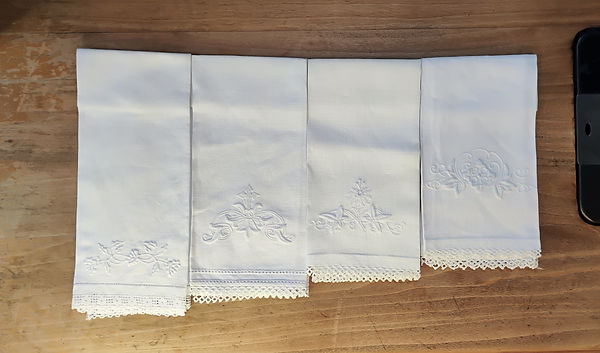
Among the many linen purificators that have come through our workroom for repairs is this collection, beautifully embroidered and stitched. We are smitten!

Isn’t this a delicious little number!? Behold the hand embroidered, double hem stitched, hand tatted, hand stitched glory!!
Please, please, join us in our mission to return these beauties to the altars of the world. Yes they will take a few minutes to make, but consider the making of them as an act of worship. Even a medium-skilled needle wielder should be able to copy this. There will be a temporary loss of some screen time. Your soul will rejoice and be healed. Your people will delight in the beauty of you, quietly stitching a masterpiece for your own parish altar, over there in that comfy chair by the window with your feet tucked up and a cup of tea on the table beside you. If your current situation is more of a wedge-a-chair-under-the-door-for-a-few-minutes-of-quiet variety, you may need this project even more. Take a breather and immerse yourself in something beautiful.

Here’s the Passion Flower edition! It has served so many Masses that the two vertical folds have worn through in several spots. Shouldn’t we replace it with a copy? How could we not do so?!
We firmly believe that your priest needs one of these too. He is likely to have an episode of temporary paralysis upon his first encounter with one of these purificators (I have seen this phenomenon on a few occasions).

We’re calling this one the Trailing Vine design. I love those long twirling ends meandering off to the outer edges!


They also have their own matching crosses!
The chain stitch line work in each of these designs was created using a Cornely chain stitch machine with a fine hook and thin thread—a combination that the large vestment-making convents used beautifully and often, back in the days before polyester. The machine did make the chain stitch embroidery faster, but it came with a major downside, in that it tended to spoil the contemplative atmosphere which should be attached to the crafting of one of these beauties. It is very loud and oily, looking like it could shred a Nun if she wasn’t careful around the business end of the contraption. I have to wear earplugs if I run it at high speeds. Its invention, in 1874, and subsequent sales calls, brought forth deep indignation from the good Mother Superiors who ran the embroidery departments. They were horrified at the mere idea of introducing that monstrous machine into their ateliers. “Can you not sew with me for one hour?” They held out for a good long time...
We held out for a long time too, although that was mostly because we didn’t know there was such a thing as a Cornely chain stitch machine. I had repeated bouts of despair, brought on by yet another intense encounter with the exquisite embroidery on a cope, brought in for repairs. There they were again, miles and miles of perfect chain stitch details in an explosion of color and texture. How did these nuns achieve such perfectly spaced chain stitches!!??!!?? They were freaking machines!!! I just could not achieve such evenness in my stitches, not matter how much I practiced. It turns out that it was actually a machine, so we purchased one, and once we learned to drive the thing properly, the stitching of a large vesperale went from 180 hours down to 6.
But I digress a little. The point is, I don’t think I would ever use a Cornely on a purificator. These precious linens beg to be tenderly, and reverently sewn with sacred attention.
The chain stitching areas are perfectly doable by hand—a surprisingly enjoyable undertaking, but can also be achieved with a stem stitch or split stitch.

This is the Rambling Rose design. So pretty!
And speaking of rambling, with apologies, I am not quite finished with the machine assisted embroidery saga.
A few years ago a priest reached out with a request to meet and talk about altar linens. I assumed he needed help procuring a good set for his parish, but instead he succinctly laid out a painful dilemma. The largest supplier of church goods routinely acquires companies that have supplied parishes with good quality items needed for liturgies. Then they quickly outsource production to foreign countries, some of whom are openly hostile to our faith. Cost savings seems to be their primary goal. I have encountered the distressful tanking in quality. I had to stop embroidering ready-made amices (with the Cornely), because I was finding, chips of wood, and random shop floor trash in the ties, the linen was suddenly yellow and very thin, cotton twill ties were replaced with stiff plastic that was prone to come untied during Mass. The cut was way off grain and taking on strong trapezoid characteristics. The crosses were sometimes upside down. (!)
That is not even the worst part. This priest did some investigating, and it confirmed things that I was hearing. After the production broker finishes his tour of the nice shiny, happy factory, and returns to the states, the whole project is often moved to the reeducation camps where prisoners, who haven’t slept well and need more food, are put to work for long hours making our church linens.
“Blasphemy!” was how he described it.
So he was setting up a web store with a plan to offer good church linens at cost, just so he, and other like-minded priests, would have an ethical source. Would I train some people to make them?
We accidentally poached his sewing lady, with an agreement to add alter linens to our expanding web store, since he didn't really want to deal with all of that anyway.
This was our first time using machines to make the linens, and it was painful, but we set out to make them as nicely as we could.

However, to get back to the whole point of this Purificator Embroidery Glory page. Making these by machine is rather distressing for us. It clashes with the great and perfect gift that should permeate this endeavor—a needle and linen in hand, worked by a devoted parishioner, creating altar linens for her own parish as an act of worship. The spiritual river that runs through the process is the true gold, and purposefully tapping into that will produce enormous and surprising graces. I way underestimated the power and scope of this aspect of our work.
So, please, embark on this hand stitched purificator journey. I promise that you and your parish will reap untold benefits.
Below are links to four pdf files available for download. Each page includes detailed photos so you can see how the stitches should go, along with line work drawn to size for you to trace on some fine linen.


~ Pre-shrink your linen.
~ Give your linen a couple of really light applications of spray starch on both sides before stitching to stabilize it. This will also make it easier to trace the design.
~ We like the 6" bamboo embroidery hoops, for these smaller embroideries. Get one with a phillips tightening screw. Wrap the inner ring with narrow twill tape, making sure there is an even, not-overlapping, layer, and stitch the ends down on the inside of the hoop. It will take about 3 yards of 1/4" twill tape. A small binder clip or two will help hold things in place as you go along.

~ We often use this inexpensive hoop stand for two-handed stitching. They're readily available from lots of vendors for around $15
Embroidered Reversible Cross
